 Systems at the heart of strategic sectors—defense, aeronautics, security, and critical infrastructure—no longer operate in isolation. An aircraft, drone, ship, or command system now functions within a complex, interconnected ecosystem, integrating sensors, software, communication networks, human operators, and autonomous components.
To address these challenges, Institut Polytechnique de Paris (IP Paris) has launched the ASC Chair (Architecture of Complex Systems), in collaboration with major industrial and institutional partners. Its mission: designing global architectures that integrate emerging technologies—such as artificial intelligence and increased autonomy—without compromising the critical requirements of these systems.
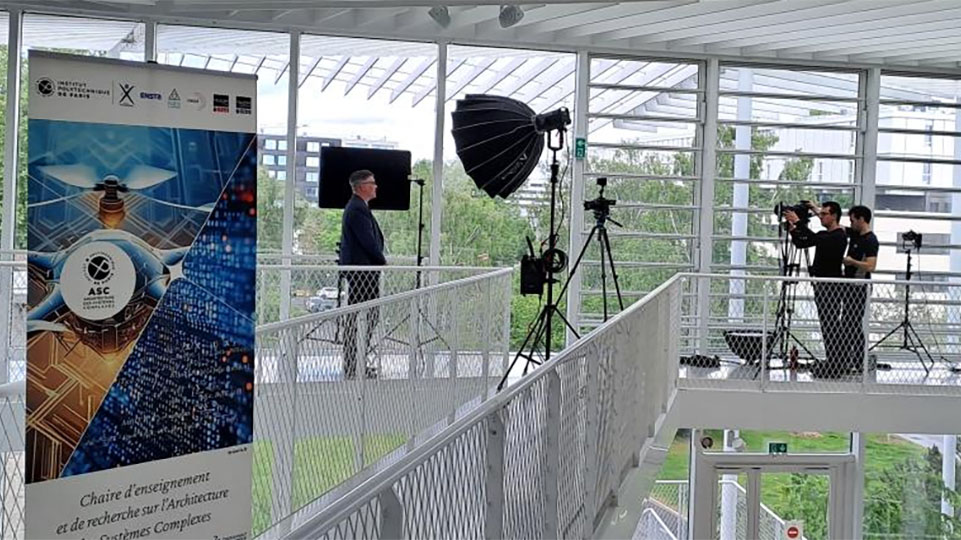
Key Objectives of the ASC Chair
The ASC Chair aims to:
- Develop system engineering methods to design architectures capable of adapting to uncertain environments.
- Integrate disruptive technologies (AI, autonomy, advanced networks) while ensuring reliability and resilience of systems.
- Federate academic and industrial stakeholders around concrete projects to translate theoretical advancements into operational solutions.
- Train future engineers and researchers in the challenges of complex system architecture through specialized courses (such as MBSE) and student projects (ASC Challenge).
The ASC Chair at Télécom Paris is built on three scientific pillars, led by renowned teacher-researchers:
- Georgios Bakirtzis: He leads research on autonomous decision-making, with projects on preference-aware systems, contingency games, and learned world models for robotics. His work supports a course project on algorithmic decision-making and is reinforced by the Hi! Paris invited chair, awarded to David Fridovich-Keil.
- Dominique Blouin: A specialist in Model-Based Systems Engineering (MBSE), he develops tools to represent, analyze, and design architectures for complex systems. His work is integrated into teaching through the MBSE course and the ASC Student Challenge, enabling students to apply these methods to real-world cases.
- Laurent Pautet: An expert in critical embedded and real-time systems, he contributes to the design of deterministic platforms and the verification of non-functional properties (synchronization, performance, safety, security). His research is essential to ensure that embedded systems, often subject to strict constraints, operate in a predictable and reliable.
Together, these three axes connect system architecture, implementation guarantees, and intelligent decision-making, offering an integrated and interdisciplinary approach to tackle the challenges of complex systems.
Partners
The ASC Chair is supported by Dassault Aviation, Dassault Systèmes, Naval Group, KNDS France, and the French Defense Innovation Agency (AID). It involves École polytechnique, ENSTA, Télécom Paris, and Télécom SudParis under the Institut Polytechnique de Paris.
Project management for the ASC Chair is ensured by the Interdisciplinary Center for Defense and Security Studies (CIEDS)
Follow, contact and useful links
ASC chair
CIEDS X’Novation Center
Avenue Coriolis
F-91120 Palaiseau
contact mail