


Signal, Statistique et Apprentissage (S2A)Signal, Statistics and Learning (S2A)
Laboratoire :Laboratory:
Laboratoire Traitement et Communication de l'Information (LTCI)Information Processing and Communication Laboratory (LTCI)
Département :Department:
Image, Données, Signal (IDS)Image, Data, Signal (IDS)
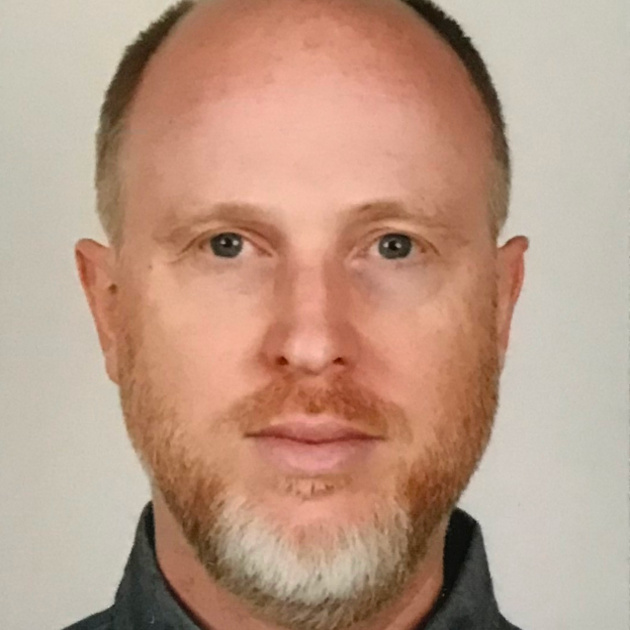
Roland Badeau is Full Professor in the Signal, Statistics and Machine learning (S2A) team of the Image, Data, Signal (IDS) Department at Télécom Paris. His research interests focus on statistical modeling of non-stationary signals (including adaptive high-resolution spectral analysis and Bayesian extensions to NMF), with applications to audio and music (source separation, denoising, dereverberation, multipitch estimation, automatic music transcription, audio coding, audio inpainting). He is a co-author of over 30 journal papers, over 130 international conference papers, a book chapter and 4 patents.
Statistical wave field theory
The statistical wave field theory establishes the statistical laws of the solutions to the wave equation in a connected and bounded domain, which hold at high frequency and after many reflections on the boundary surface. It thus provides the mathematical solution to a long-standing problem in room acoustics, which has been the subject of extensive research since the pioneering work of Wallace Clement Sabine in the late 19th century: the physical modeling of reverberation.
News: Two new preprints are available
Roland Badeau. Geometrical acoustics meets the statistical wave field theory. 2026. ⟨hal-05683792⟩
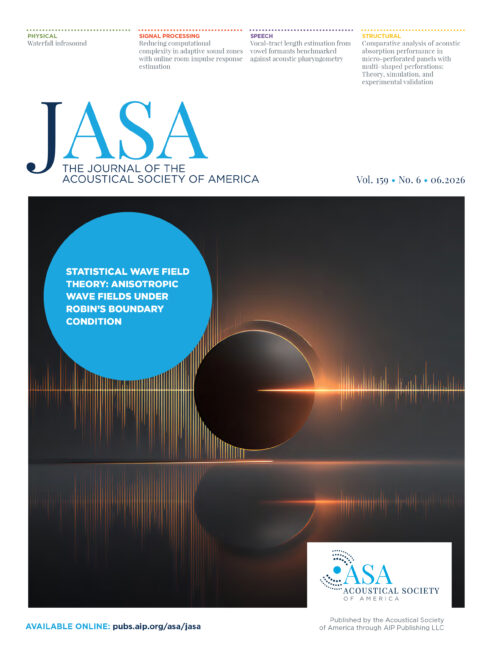
News: The statistical wave field theory is featured on the JASA June cover!
Publications related to the statistical wave field theory
Roland Badeau. On the spectral decomposition of the complex Robin Laplacian. Journal of the Acoustical Society of America, 2025, 158 (1), pp. 838-848.
Copyright (2025) Acoustical Society of America. This article may be downloaded for personal use only. Any other use requires prior permission of the author and the Acoustical Society of America.
Download updated preprint, including minor corrections posterior to publication (dated December 8, 2025)
Roland Badeau. Statistical wave field theory. Journal of the Acoustical Society of America, 2024, 156 (1), pp. 573-599.
Copyright (2024) Acoustical Society of America. This article may be downloaded for personal use only. Any other use requires prior permission of the author and the Acoustical Society of America.
Download updated preprint, including minor corrections posterior to publication (dated December 8, 2025)
Albert G. Prinn and Roland Badeau. Verification of statistical wave field theory reverberation time predictions. Applied Acoustics, Volume 250, 2026, 111337.
Published by Elsevier Ltd. This is an open access article under the CC BY license.
Download article
Roland Badeau. Statistical wave field theory: Curvature term. Journal of the Acoustical Society of America, 2025, 157 (3), pp. 1650-1664.
Copyright (2025) Acoustical Society of America. This article may be downloaded for personal use only. Any other use requires prior permission of the author and the Acoustical Society of America.
Download updated preprint, including minor corrections posterior to publication (dated December 8, 2025)
Roland Badeau. Statistical wave field theory: Special polyhedra. Journal of the Acoustical Society of America, 2025, 157 (3), pp. 2263-2278.
Copyright (2025) Acoustical Society of America. This article may be downloaded for personal use only. Any other use requires prior permission of the author and the Acoustical Society of America.
Download updated preprint, including minor corrections posterior to publication (dated December 8, 2025)
Roland Badeau. Statistical wave field theory: Anisotropic wave fields under Neumann’s boundary condition. Journal of the Acoustical Society of America, 2026, 159 (3), pp. 2265–2280.
Copyright (2026) Acoustical Society of America. This article may be downloaded for personal use only. Any other use requires prior permission of the author and the Acoustical Society of America.
Download preprint (dated March 12, 2026)
Roland Badeau. Statistical wave field theory: Anisotropic wave fields under Robin’s boundary condition. Journal of the Acoustical Society of America, 2026, 159 (6), pp. 5359-5377.
Copyright (2026) Acoustical Society of America. This article may be downloaded for personal use only. Any other use requires prior permission of the author and the Acoustical Society of America.
Download preprint (dated June 17, 2026)
Other research themes
- Data representation: dimensionality reduction, time-frequency analysis (high resolution)
- Modeling: probabilistic latent variable models, source models (positive matrix factorizations, sinusoidal models, sparse models, etc.), propagation models (convolutional, diffuse)
- Algorithms: Bayesian estimation, optimization methods, fast adaptive algorithms, performance analysis, convergence speed, numerical stability, algorithmic complexity
- Applications to audio signals: source separation/localization, audio coding, restoration, denoising, dereverberation, sound scene analysis, music information retrieval
- Other applications: biomedical data analysis, digital communications, image processing
Teaching
- Engineering training at Télécom Paris, 1st year and Master cycle (2nd and 3rd years, M1&M2 levels): Applied Mathematics and Signal Processing
- Master 2 ATIAM, Sorbonne Université: Music signal processing
- Master 2 MVA, ENS Paris-Saclay: Audio-frequency signal analysis
- Master 2 CIMES, ESPCI and Sorbonne Université: Signal and image processing, statistics
Responsibilities
- Supervision of doctoral and master’s theses
- Supervision of teaching units at Télécom Paris and in the ATIAM and MVA M2 programs
- Supervision of the TSIA study track (Signal Processing for Artificial Intelligence) at Télécom Paris
- Correspondent of the Master ATIAM at Télécom Paris


"Top 2%": our faculty members among them
Faculty Members — 26/09/2024This ranking of excellence drawn up by Stanford features more than 210,000 researchers out of more than 8 million active scientists [...]«Top 2%» : nos enseignants-chercheurs en font partie
Faculty Members — 24/09/2024Ce classement établi par Stanford présente 210000 chercheurs, soit 2,5% des 8 M de scientifiques actifs dans le monde.
Prix de Thèse IP Paris : trois doctorants de Télécom Paris parmi les lauréats
PhD — 01/07/2022Le prix de thèse IP Paris a été décerné le 1er juillet 2022 à sept lauréats, parmi lesquels figurent [...]
Kimia Nadjahi, prix du meilleur article étudiant à ICASSP 2020
PhD, Data Science & AI — 06/05/2020Kimia Nadjahi a reçu le prix du meilleur article étudiant pour "Méthode d'Approximate Bayesian [...]Best student paper award to Kimia Nadjahi at ICASSP 2020
PhD, Data Science & AI — 06/05/2020Kimia Nadjahi received the best student paper award for "Approximate Bayesian Computation with the [...]