


Équipe de recherche :Research Team:
Télécommunications Optiques (GTO)Optical Telecommunications (GTO)
Laboratoire :Laboratory:
Laboratoire Traitement et Communication de l'Information (LTCI)Information Processing and Communication Laboratory (LTCI)
Département :Department:
Communications et Électronique (Comelec)Communications and Electronics (Comelec)
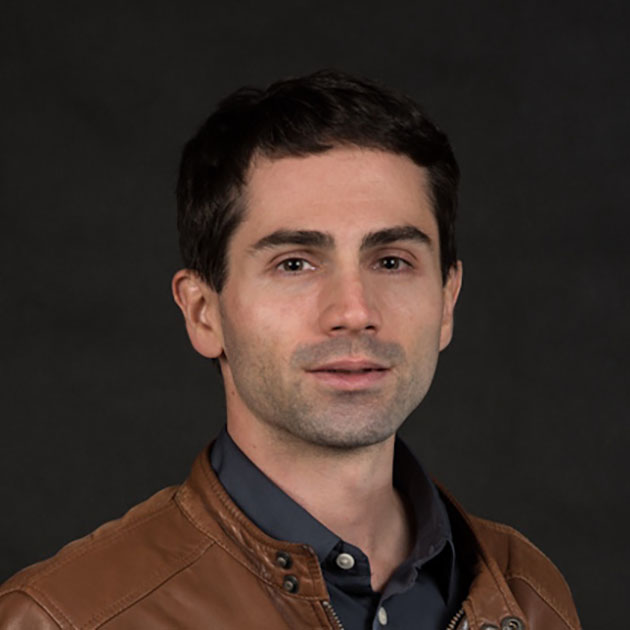
Nicolas Fabre is an Associate Professor (maître de conférences) at Telecom Paris in theoretical quantum optics and information, at Télécom Paris in the GTO team (Group of optical telecommunication).
Nicolas Fabre obtained his PhD from Université Paris Diderot in 2020 within the Matériaux et Phénomènes Quantiques (MPQ) laboratory. His PhD work investigated phase-space methods in quantum optics, modular variables, and the use of the time-frequency degree of freedom of single photons for quantum computing and metrology applications.
Before joining Télécom Paris, Nicolas Fabre held postdoctoral positions in several European research institutions. In 2022, he worked as a postdoctoral researcher in quantum optics at Universidad Complutense de Madrid, after previously conducting research at the Centre of New Technologies University of Warsaw between 2020 and 2021.
Research activities
Time-frequency quantum information processing
Quantum metrology
We explore how time-frequency variables can enhance time and frequency estimation protocols. Hong-Ou-Mandel (HOM) interferometry leverages quantum two-photon interference to improve time-delay precision. By engineering the spectral distribution of biphoton states, we analyze the metrological advantage of non-Gaussian time-frequency distributions. We then extend the discussion to multi-photon states, revealing a trade-off: while increasing photon number in entangled EPR states enhances entanglement, it also amplifies frequency noise, limiting time-shift estimation precision.
Quantum communication
Investigating measurement of quantum fields and its impact in quantum communication protocols.
Time and frequency operators, chronocyclic phase space
The time and frequency as continuous quantum variables of single photons are typically discretized into modes for experiments but not fundamentally required. Their quantum nature arises from the non-commutativity of time and frequency operators, which are well-defined in the one-photon-per-mode subspace. This allows for a universal gate set in this subspace. These gates can be physically implemented and their effects, highlighting that challenges stem from physical encoding rather than Hilbert space dimensionality.
Phase space representation of quantum systems
Quantum computing usefulness
Quantum information can be encoded using discrete or continuous variables, with the identification of useful quantum states and gates being crucial for universal quantum computation. Quantum states are often represented through density matrices or phase-space distributions, such as the Wigner distribution, whose positiveness indicates the potential for classical simulation.
Our research focuses on developing a comprehensive framework using phase-space techniques to accurately identify quantum resources in encoded quantum computations, advancing the understanding and application of quantum information processing.
Teaching activities
- Coordinator of the course « Introduction in quantum technologies », 21h (1st year Télécom Paris) 2023-
- Tutor Practical work in Photonics, 12h (1st year Télécom Paris), 2023-
- Coordinator of the course « Quantum technologies » 25,5h (2nd year Télécom Paris), 2024-
- Non-linear quantum optics, 3h, (M2 QLMN), 2023-
- Coordinator of the course « Quantum communication » 17h, M2 QLMN, 2023-
- Executive education on Quantum communication (24 Sep. 2025)