


Smartphone Circular Economy & Buy-Back Policies
26 January 2026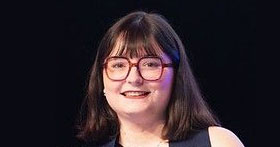
Tiphaine George, ENSTA Paris graduate and CIFRE PhD student at Orange Innovation and Télécom Paris (photo LinkedIn)
The IP Paris Research Day held at Télécom Paris on December 1, 2025, was dedicated to numerical modeling and the ecological transition. Twenty-one PhD students from the Institut Polytechnique de Paris had the opportunity to present their research by pitching their doctoral work to the scientific community… within one minute!
On the occasion of the REFLEXIONS 2026 Conference at IP Paris about Energy Transition, this is a look back at several topics presented in December, representative of the research conducted in this field at IP Paris.
What is your PhD research about?
My research is conducted in a context where information and communication technologies account for 4% of global emissions and have a significant environmental impact. It focuses on the mathematical modeling of the circular economy applied to smartphones. The main objective is to analyze how buy-back policies—offered to consumers when they replace their devices—can help reduce pollutant emissions and waste.
While such measures encourage recycling and refurbishment, they may also incentivize the purchase of new devices and more frequent replacement cycles. This raises questions about their actual effectiveness, the expected environmental benefits, and the design of optimal policies.
To address this, I developed an innovative analytical model that simultaneously captures these conflicting effects and identifies an optimal buy-back value. The model includes several categories of phones (premium, basic, refurbished), assumes that a central actor controls the buy-back price of premium devices and influences replacement frequency and return rates, and segments consumers based on their sensitivity to buy-back incentives to reflect real-world behavior. The influence of additional factors, such as eco-design and consumer awareness, is also assessed.
What are the direct or potential applications?
This model is primarily relevant for stakeholders involved in smartphone life-cycle management, including operators, refurbishers, and public decision-makers. It serves as a decision-support tool for designing public policies or corporate strategies and for evaluating the environmental impact of buy-back schemes. It helps identify optimal approaches to promoting sustainability by balancing the collection of used phones with replacement frequency.
More broadly, this methodological framework can be adapted to other sectors involving buy-back and resale of second-hand products (automotive, household appliances, electronic equipment), opening new pathways toward an industrial-scale circular economy.
What motivated you to pursue a PhD in this field?
I had the opportunity to complete an internship on this topic prior to my PhD, and the experience convinced me to continue along this path.
This work also mobilizes my core expertise in optimization and allows me to apply it to a concrete, high-impact domain. I feel supported in developing models aligned with my scientific interests, making this PhD a natural and motivating continuation of my academic journey.